

How to Safely Introduce a Cat to a Dog
Introducing a new furry family member to your household is an exciting event, but mixing cats and dogs doesn’t always go smoothly.
Even in play, dogs have the potential to cause serious harm to cats, and vice versa. To ensure a safe introduction and avoid injury and confrontation, there are a few measures you can take to conduct your introduction in paw-fect harmony.
When integrating dogs and cats in your household, explore our step-by-step process for introducing your pets safely and with confidence.
Days 1-3: The Separate Setup
The process of introducing your cat and dog safely begins well before the physical introduction, and the safety timeline cannot be rushed.
Use the Fortress Strategy
For the first 72 hours that your new pet is in your home, you should separate that cat or dog from your existing pets. For example, if you keep your dog in your downstairs living room, you could keep your cat in an upstairs bedroom.
Physically separating the animals has numerous benefits:
- Subtle acclimatization: Although the animals may not be able to see each other, they may be aware of a new scent or sound in the house. Separating the animals enables them to slowly become conscious of one another, without shocking them with an immediate introduction.
- Sense of security: When you move a new pet into your home, they may experience feelings of anxiety and fear. Before overwhelming them by introducing them to another animal, separating your new pet allows them to become familiar with and comfortable in their new surroundings.
- Prevents overstimulation: Both cats and dogs can become overstimulated in new or stressful situations. Delaying the introduction helps reduce a dog’s unpredictability and the cat’s fearfulness or defensiveness.
Foster Resource Independence
While separated, your cat and dog should each have access to their own food and water bowls and — if needed — litter box.
Giving each pet their own resources can help them feel relaxed and prevent resource guarding. Resource guarding happens when an animal becomes overly protective of their food, drink or other objects. It can result in aggressive or violent behavior, which can create dangerous situations between your pets and put their safety at risk.
Exchange Scents
One of the most effective ways to gradually introduce your pets to one another is to exchange their scents to build positive associations.
You can do this by rubbing an item of clothing, like a sock, under your cat’s neck and mouth and placing that sock under the dog’s food bowl or feeder. You can repeat the process the other way around, too.
By placing an item with one animal’s scent near the other animal’s food, they may begin to associate the smell with something positive. This process helps familiarize the animals with each other’s scents and minimizes the risk of confrontation when you eventually introduce them.
Days 4-7: Visual Desensitization
Once both animals have acclimated to each other’s scents, you can slowly begin to introduce them visually. Use the visual desensitization approach for three to four days before advancing to the next step.
Maintain a Barrier
Although you should keep them physically separated from each other, you can introduce your cat and dog through baby gates, slightly opened doors or windows. Restrain each animal to make sure they cannot reach or touch each other.

Practice Parallel Feeding
To continue building a positive relationship between your cat and dog, you can start feeding them at the same time on opposite sides of a barrier, such as a closed door or baby gate.
This strategy will strengthen their positive associations with each other, and they will continue to associate good things — like food — with seeing, hearing or smelling the other animal.
To ease both animals into the parallel feeding process, you can start with their bowls a few meters away from the barrier on either side and gradually move them closer to the barrier with each feeding. Hopefully, you will get to the point where both animals are relaxed when close to each other.
To maximize the effectiveness of this integration method, consider using a slow feeder for your dog. Dogs generally finish their meals more quickly than cats, but the longer it takes for your dog to finish their meal, the less time they will spend looking at the cat or getting excitable.
Stay Vigilant
Even when they cannot reach each other, your pets may show signs of aggression when they can see one another. It is crucial that you notice intimidating or potentially threatening behavior and discourage it.
For example, you might be able to determine how your dog views your cat by their body language or the way they stare at the cat. Predatory body language can be characterized by an intense stare, rigid body, stalking, raised hackles and unwavering focus.
Similarly, your dog may display threatening behavior in the way they vocalize. Concerning vocalizations include growling and barking.
If your dog exhibits any of these behaviors when being visually introduced to your cat, increase their distance immediately to discourage them from repeating the behavior.
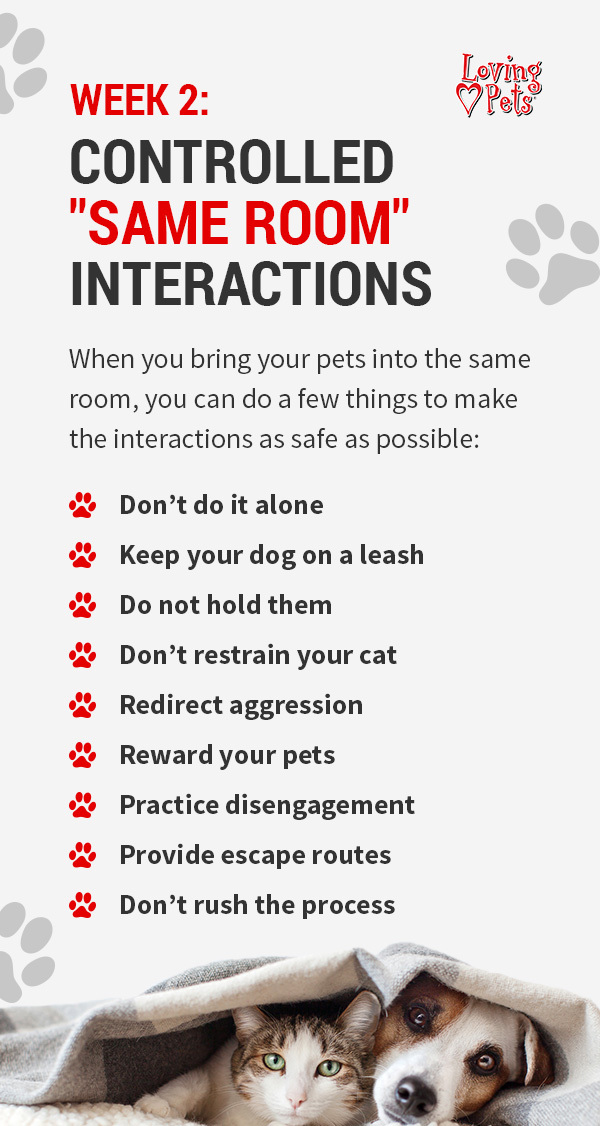
Week 2: Controlled "Same Room" Interactions
If your pets have both shown that they are comfortable with one another’s presence from a distance, you can try to introduce them in the same room, without barriers.
Arrange these initial interactions in a neutral area of your home, and not in either of the animals’ separate spaces, to help avoid protective or possessive behavior. At first, you should keep these interactions short and sweet. After a few successful sessions over the course of multiple days, you can increase the time they spend in the same room.
When you bring your pets into the same room, you can do a few things to make the interactions as safe as possible:
- Don’t do it alone: It can be challenging to introduce your pets alone. If you can, enlist the help of a partner, roommate, friend or family member.
- Keep your dog on a leash: Restrain your dog by a leash at all times during their first same-room interactions with your cat to ensure they can’t cause any harm.
- Do not hold them: Although your dog should be restrained by a leash, you should not hold either animal in your arms to prevent harm to yourself.
- Don’t restrain your cat: Allow your cat to come and go as they please, unless they show any aggression toward your dog. You can entice your cat into the room with a toy or treats.
- Redirect aggression: If either animal acts aggressively, immediately and calmly try to redirect their attention away from the other pet.
- Reward your pets: You can instruct your dog to sit and reward them with treats when they follow your commands or act calmly. You can also reward your cat with treats to help them feel safe.
- Practice disengagement: When your dog is looking at your cat, call their name to discourage them from focusing too intensely on the cat. When your dog successfully disengages on command, reward them with treats.
- Provide escape routes: To help your cat feel relaxed during these interactions, you should offer them escape routes, using vertical cat trees or an open door. This lets them know they are not trapped and can retreat if they feel threatened.
- Don’t rush the process: Continue these on-leash interactions until both animals can coexist in a room calmly. For example, don't remove the leash from your dog until they can spend time in the same room as the cat without reacting to them, or until your cat can eat or use the litter tray comfortably.
Week 3: Loose Interactions
If you have multiple successful introductory sessions with your dog on a leash where they successfully ignore the cat, you can move on to the next step — supervised but unrestricted interactions.
Technically, your dog will still be on a leash, but you can let it drag on the floor instead of holding onto it at all times. This way, you can grab or step onto the leash and restrain your dog before any potentially aggressive behavior takes place.
Although your long-term goal might be for your cat and dog to be best friends, snuggle and become partners in crime, your initial goal should simply be for them to coexist calmly in one room.
Follow these steps for a successful unrestrained session:
- Keep a safe space for your cat: To help your cat feel safe throughout the interactions, provide a safe space for them to retreat when they feel threatened or overwhelmed. Whether it's a high-up shelf, crate or cat tower, having a space that your dog can’t reach can help streamline the interactions.
- Stay vigilant: Even if your previous controlled interactions have been successful, animals can still be unpredictable. Stay close to your dog at all times so you can restrain or distract them if you notice any concerning body language or behavior.
- Never leave them unsupervised: Until you have completed multiple successful unrestrained sessions, don't leave your pets in the same room without total supervision.
- Take a step back if needed: If your pets consistently fail to make progress, or if either of them continues to demonstrate aggressive behavior, you can always take a step back and go back to more controlled sessions. Slow and steady wins the race, and the safety of your pets should always come first.
Recognizing Red Flags: When to Stop
Progress isn’t always linear, and you might have to pause your interactions if either one of your pets demonstrates aggression or discomfort.
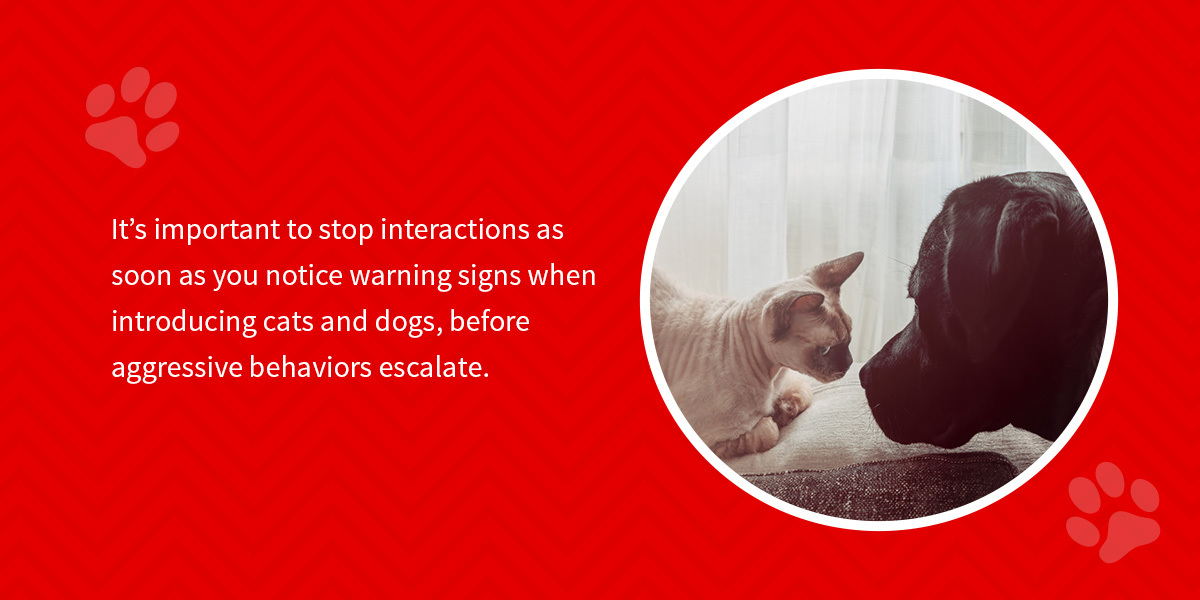
It’s important to stop interactions as soon as you notice warning signs when introducing cats and dogs, before aggressive behaviors escalate.
Signs to look out for in a cat include:
- Flattened ears: If a cat flattens their ears, it can either be a sign of fear or annoyance.
- Dilated pupils: Dilated pupils can signify a wide range of things. However, if your cat’s eyes dilate during introduction sessions with your dog, it can be a sign that they are scared.
- Upright tail: A stiff and upright tail can signal annoyance or aggression.
- Arched back: Particularly when combined with on-end fur, an arched back demonstrates aggression.
- Hissing: If your cat hisses or spits, it might indicate stress or fear.
Signs to look out for in a dog include:
- Whale eye: “Whale eye,” otherwise known as dorsal gaze — or, more casually, side-eye — is when a dog displays more of the whites of their eyes than their pupils.
- Showing teeth: If your dog bares their teeth, you should take it as a warning sign of aggression. It could signal that more aggressive behavior will follow.
- Stalking: Stalking is a common part of a predator’s approach to their prey. It can be characterized by walking close to the ground, slow, deliberate movements and an intense focus on your cat.
Special Considerations for Kittens and Puppies
Introducing a new dog or cat to another pet is complicated enough, but there are special considerations when young kittens or puppies are involved.
If one or both of your pets are very young, here are some things to bear in mind when introducing them:
- Kitten vulnerability: Kittens are extremely small, fragile and delicate creatures. Even a playful pat or nudge from a dog or puppy could cause serious injury to a kitten. When introducing a kitten to a dog, you should take extra precautions to guarantee their safety.
- Puppy excitability: Puppies tend to have higher energy levels than adult dogs. Consequently, they can act more unpredictably and may require a more controlled approach.
- Training: As puppies are likely less trained than adult dogs, it may be harder to redirect their attention from the cat, practice disengagement or restrain them. You may need to enlist more help or spend more time on controlled interactions before moving to the next stage.
- Potty training: Young kittens and puppies may not be potty trained, which could make introductory sessions a little more complicated — and messy. If you are introducing a kitten or puppy to your existing pet, consider prepping the space with additional supplies, like training pads.
- Other pets: If you are introducing a puppy or a kitten to multiple existing pets, consider how it might affect other pets differently. For example, a puppy can incite a stronger prey drive or sense of protectiveness in an adult dog, which might affect how both act around a cat or kitten.